Chinese
 English
 français
 italiano
 español
 português
 Nederlands
 日本語
日本語 한국의
한국의




- So wählen Sie einen Batterieslurry-Mischer für die industrielle Produktion aus
- Vergleich der Stapel- und Wickelverfahren bei der Montage von Batteriezellen
- Eine technische Roadmap von der Batterielaborlinie und Pilotlinie bis hin zu Lösungen für vollmaßstäbliche Batterieproduktionslinien
- TOB NEW ENERGY: Chinesischer Anbieter integrierter Batterielösungen für Ausrüstung und Materialien bis hin zu schlüsselfertigen Produktionslinien
- TOB leitender Ingenieur zum Industrie-Absolventen-Mentor der CSU ernannt
Leitfaden für Festkörperbatterie-Fertigungsausrüstung 2026–2027
Herstellung von Festkörperbatterien: Worauf sich Käufer von Anlagen 2026–2027 vorbereiten sollten
Ankündigungen zu Festkörperbatterien erscheinen wöchentlich. OEMs versprechen Produktionszeitpläne, die sich von Quartal zu Quartal verschieben. Materialunternehmen behaupten Durchbrüche bei der Sulfid-Leitfähigkeit. Dennoch bleibt die Lieferkette für Fertigungsanlagen – die tatsächlichen Maschinen, die Pulver in fertige Zellen umwandeln – der am wenigsten diskutierte und kritischste Engpass.Der Übergang von Lithium-Ionen-Batterien mit Flüssigelektrolyt zu Festkörperbatterien ist keine Anpassung. Es ist ein Ersatz. Eine Standard-Lithium-Ionen-Produktionslinie kann nicht auf Festkörpertechnologie „aufgerüstet“ werden. Die Spezifikationen des Trockenraums, der Elektrodenbildungsprozess, die Stapelmontagemethode und das Formierungsprotokoll erfordern alle grundlegend unterschiedliche Anlagen.
Für Batteriehersteller, die ihre Investitionsausgaben für 2026–2027 vorbereiten, identifiziert dieser Leitfaden die vier Anlagenbereiche, in denen sich die Spezifikationen ändern, die aktuelle Lieferantenlandschaft und die Kostenfolgen, die jetzt eingeplant werden müssen.
Der Anlagenumbruch: Was sich von Lithium-Ionen zu Festkörperbatterien ändert
Eine herkömmliche Lithium-Ionen-Linie ist auf Flüssigelektrolyt ausgelegt. Die Festkörperlinie eliminiert diesen. Diese einzelne Änderung zieht sich durch jede Station.
| Fertigungsschritt | Lithium-Ionen (flüssig) | Festkörper | Auswirkungen auf die Anlagen |
| Elektrodenvorbereitung | Nassschlicker-Beschichtung + Trocknung | Trockenmischung + Kalandrierung oder Schlickerbeschichtung + Lösungsmittelentfernung | Lösungsmittelrückgewinnungssysteme entfallen; Trocken-Elektrodenlinien werden hinzugefügt |
| Elektrolytanwendung | Flüssigbefüllung unter Vakuum | Abscheidung oder Laminierung einer Festelektrolytschicht | Befüllstationen werden durch Laminier- oder Pressstationen ersetzt |
| Zellmontage | Stapeln/Wickeln + Elektrolytfüllung + Versiegelung | Stapeln unter Druck + isostatisches Pressen + Versiegelung | Hydraulische/isostatische Presse als Engpassstation hinzugefügt |
| Spezifikation des Trockenraums | Taupunkt -40 °C | Taupunkt -60 °C (Sulfid), -50 °C (Oxid) | Gesamtes HLK-System muss neu spezifiziert werden; Investitionskosten 2–3× höher |
| Formierung | SEI-Bildungszyklen bei 25–45 °C | Druckbegrenzte Zyklen bei 25–80 °C | Formierungsvorrichtungen müssen Stapeldruck ausüben und aufrechterhalten |
Ein Hersteller mit einer bestehenden Lithium-Ionen-Linie steht vor einer Entscheidung: eine separate Festkörperlinie bauen oder die bestehende Linie verschrotten und ersetzen. Es gibt keinen Nachrüstweg, der nicht Kosten und Leistung beeinträchtigt.
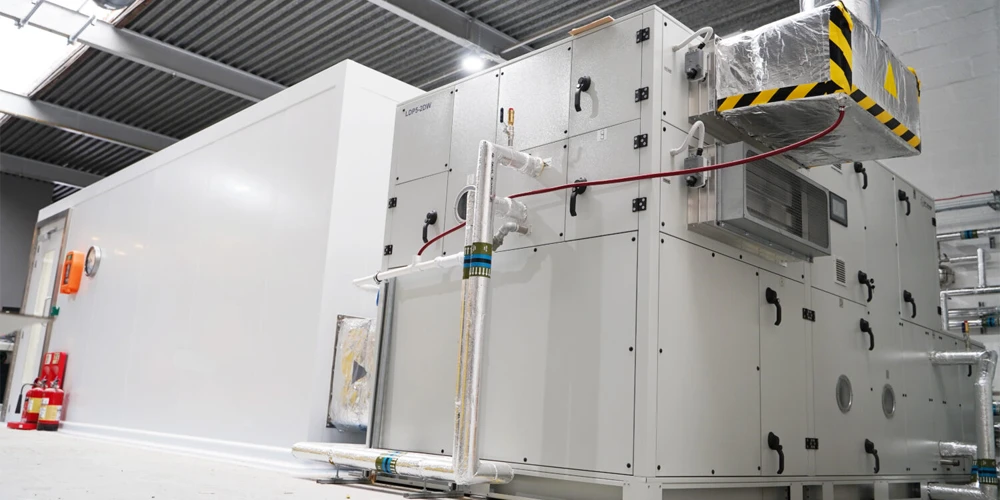
1. Trockenrauminfrastruktur: Die Spezifikation, die jeden Käufer überrascht
Sulfid-Festelektrolyte – der führende Kandidat für Festkörperzellen mit hoher Leitfähigkeit – reagieren mit Feuchtigkeit und erzeugen Schwefelwasserstoffgas. Selbst bei Konzentrationen im ppm-Bereich verschlechtert diese Reaktion den Elektrolyten und erzeugt eine Toxizitätsgefahr.
Vergleich der Trockenräume:
| Parameter | Lithium-Ionen-Standard | Festkörper (Sulfid) | Festkörper (Oxid) |
| Taupunkt | -40 °C | -60°C | -50°C |
| Feuchtigkeit (H₂O) | |||
| Sauerstoff (O₂) | |||
| HVAC-Investitionskosten (1.000 m²) | $1.5–2.5M | $4.5–7.0M | $3.0–4.5M |
| Energieverbrauch (kWh/Jahr) | 800–1,200 MWh | 2,500–3,500 MWh | 1,800–2,500 MWh |
Die Taupunktspezifikation ist nicht verhandelbar. Der Betrieb einer Festkörper-Sulfid-Linie bei einem Taupunkt von -50°C – nur 10°C über den erforderlichen -60°C – erzeugt innerhalb weniger Stunden messbares H₂S. Zellen, die unter diesen Bedingungen montiert wurden, zeigen nach 50 Zyklen Kapazitätsverluste von 15–30 % im Vergleich zu Zellen, die unter -60°C montiert wurden.
Für Beschaffungsteams, die eine Festkörperproduktion planen, muss der Trockenraum vor jeglicher Prozessausrüstung spezifiziert und budgetiert werden. Ein Lieferant für Festkörperbatterie-Trockenräume und Trockengassysteme muss einen dauerhaften Betrieb bei einem Taupunkt von -60°C mit Echtzeitüberwachung über die gesamte Produktionsfläche nachweisen, nicht nur an Sensorpunkten in der Nähe der Luftbehandlungsgeräte.
2. Isostatisches Pressen: Die neue Engpassstation
Festkörperzellen erfordern einen innigen Feststoff-Feststoff-Kontakt zwischen Elektrolytpartikeln und aktivem Elektrodenmaterial. Dieser Kontakt wird durch Hochdruck-Isostatisches Pressen erreicht – nicht durch das leichte Kalandrieren, das für Flüssigelektrolyt-Elektroden verwendet wird.
Spezifikationen für isostatisches Pressen:
| Parameter | Kaltisostatische Presse (CIP) | Warmisostatische Presse (WIP) |
| Druckbereich | 200–600 MPa | 100–400 MPa |
| Temperaturbereich | Umgebungstemperatur | 40–150°C |
| Zykluszeit (pro Zellstapel) | 2–5 Minuten | 5–15 Minuten |
| Ausrüstungskosten pro Station | $200,000–350,000 | $300,000–500,000 |
| Durchsatz (Zellen pro Stunde, einzelne Station) | 12–30 | 4–12 |
Für eine 100-MWh/Jahr-Festkörperlinie zur Herstellung von Pouch-Zellen mit 20 Ah werden ungefähr 4–6 isostatische Pressstationen benötigt. Die Pressstation wird zur Durchsatzbegrenzung der Linie. Anders als die Befüllung mit Flüssigelektrolyt, die sich einfach parallelisieren lässt, sind isostatische Pressgefäße Hochdrucksysteme, deren Kosten nichtlinear mit der Gefäßgröße steigen.
Der Pressparameter muss auf das Festelektrolytmaterial abgestimmt werden. Oxidelektrolyte (LLZO, LATP) erfordern höhere Drücke (300–500 MPa) und profitieren vom Warmpressen, um die Partikelverformung zu verbessern. Sulfidelektrolyte (LGPS, Argyrodit) können bei niedrigeren Drücken (150–250 MPa) gepresst werden, sind jedoch während der Handhabung zwischen Pressen und Versiegeln empfindlicher gegenüber Feuchtigkeitseinwirkung.
Lieferant von isostatischen Pressmaschinen für Festkörperbatteriensollte eine Druckgleichmäßigkeitskartierung über das gesamte Gefäßvolumen bereitstellen, mit nachgewiesener Gleichmäßigkeit von ±5 MPa bei Arbeitsdruck.
3. Trocken-Elektrodenverarbeitung: Der Wegbereiter für Festkörperkathoden
Die Architektur der Festkörperzelle eliminiert den Flüssigelektrolyten, jedoch nicht den Kathodenverbund. Die Kathode benötigt weiterhin Aktivmaterial, Festelektrolyt, leitfähigen Kohlenstoff und Bindemittel – gemischt und zu einer dichten Elektrodenfolie geformt.
Zwei Prozesswege werden entwickelt:
| Prozess | Beschreibung | Erforderliche Ausrüstung | TRL (2026) |
| Trockenmischen + Heißkalanderung | Trockenpulver wird mit PTFE-Bindemittel gemischt, fibrilliert und zu einer freitragenden Folie kalandriert | Hochschermischer, Fibrillationseinheit, beheizter Kalander | 6–7 (im Pilotmaßstab bewährt, Skalierung zur Massenproduktion) |
| Schlickerbeschichtung + Ausbrennen des Bindemittels + Sintern | Schlicker wird auf den Stromableiter beschichtet, getrocknet, Bindemittel thermisch entfernt und gesintert (Oxidelektrolyt) | Beschichtungslinie, Hochtemperaturofen (700–1.200 °C) | 4–5 (für Oxidelektrolyte im Labormaßstab demonstriert) |
Für Festkörperzellen auf Sulfidbasis ist der Weg über Trockenmischen und Kalandrieren derzeit der führende Herstellungsansatz. Er vermeidet Lösungsmittel vollständig, was entscheidend ist, da Sulfidelektrolyte mit den meisten polaren Lösungsmitteln reagieren.
Die Ausrüstung für die Trocken-Elektrodenverarbeitung unterscheidet sich in drei wesentlichen Punkten von der herkömmlichen Nassbeschichtung:
- Mischen: Hochscherendes Trockenmischen ist erforderlich, um Festelektrolytpartikel gleichmäßig im Kathodenverbund zu verteilen. Inhomogenität im Mikrometermaßstab erzeugt lokal begrenzten Ionenwiderstand.
- Kalandrieren: Die trockene Elektrodenfolie muss direkt auf den Stromableiter oder auf die Festelektrolyt-Separatorschicht kalandriert werden. Kalandrierdruck, Walzentemperatur und Geschwindigkeit müssen auf ±2 % geregelt werden, um die angestrebte Porosität zu erreichen.
- Laminierung: Der Kathodenverbund, die Festelektrolyt-Separatorschicht und die Anode (typischerweise Lithiummetall oder Graphit) müssen unter kontrolliertem Druck und kontrollierter Temperatur miteinander laminiert werden.
4. Handhabung der Lithiummetallanode: Die Aufrüstung der Sicherheitsspezifikation
Festkörperzellen mit Lithiummetallanoden führen eine Fertigungsgefahr ein, der Flüssigelektrolyt-Graphitanodenlinien nicht ausgesetzt sind. Lithiummetall ist reaktiv, duktil und in Form dünner Folien schwer zu handhaben.
Anforderungen an die Verarbeitung von Lithiummetallanoden:
| Parameter | Spezifikation |
| Dicke der Lithiumfolie | 10–50 μm (Zielwert |
| Handhabungsatmosphäre | Argon, H₂O |
| Spannungskontrolle der Folie | |
| Laminierungsdruck | 1–5 MPa, gleichmäßig bis ±0,2 MPa |
| Fehlererkennung | Inline-optische Inspektion auf Nadellöcher, Dickenabweichungen und Oberflächenverunreinigungen |
Lithium-Metallfolie ist mechanisch empfindlich. Standard-Roll-to-Roll-Verarbeitungsanlagen, die für Kupfer- und Aluminium-Stromkollektoren ausgelegt sind, können 20 μm Lithiumfolie ohne Reißen oder Faltenbildung nicht verarbeiten. Spezielle Spannungsregelungs- und Bahnführungssysteme sind erforderlich.
Für den Laminierungsschritt zwischen Anode und Festelektrolyt muss der Druck ausreichend sein, um einen engen Kontakt sicherzustellen, darf jedoch nicht so hoch sein, dass Lithium in die Festelektrolytschicht herausgedrückt wird und dadurch ein potenzieller Kurzschlussweg entsteht.
Bewertung der Lieferantenbereitschaft für 2026–2027
Die Lieferkette für Festkörperbatterieanlagen befindet sich im Anfangsstadium im Vergleich zur ausgereiften Anlagenindustrie für Lithium-Ionen-Batterien. Beschaffungsteams müssen die Lieferantenbereitschaft anhand nachgewiesener Fähigkeiten und nicht anhand von Marketingaussagen bewerten.
| Anlagenkategorie | Lieferantenreife | Geschätzte Lieferzeit (2026) | Wichtige Bewertungskriterien |
| Trockenräume (-60 °C Taupunkt) | Mittel; wenige qualifizierte Integratoren | 10–14 Monate | Nachhaltiger Taupunkt unter Produktionsbedingungen, nicht nur bei der Inbetriebnahme |
| Isostatische Pressen | Niedrig; spezialisierte Anbieter hydraulischer Systeme | 12–16 Monate | Kartierung der Druckgleichmäßigkeit; Zykluszeit unter Produktionsbedingungen |
| Trocken-Elektrodenanlagen | Niedrig; im Pilotmaßstab nachgewiesen, Hochskalierung läuft | 12–18 Monate | Bahnbreitenfähigkeit; nachgewiesene Daten zur Foliengleichmäßigkeit |
| Handhabung von Lithium-Metall | Sehr niedrig; kundenspezifische Entwicklung erforderlich | 14–20 Monate | Spannungsregelung für Dünnfolien; Fähigkeit zur Fehlererkennung |
| Montage und Versiegelung | Mittel; von Li-Ionen übernommen und aufgerüstet | 8–12 Monate | Atmosphärenkompatibilität; druckbegrenzte Versiegelung |
Beschaffungserkenntnis: Die Lieferkette für Festkörperbatterieanlagen ist noch nicht wettbewerbsfähig. Die meisten Lieferanten verfügen über eine oder zwei Pilotinstallationen, jedoch nicht über eine Erfolgsbilanz bei der Lieferung von Anlagen für die Massenproduktion. Beschaffungsteams sollten Lieferanten mit nachgewiesener Erfahrung mit Lithium-Ionen-Produktionslinien und einem aktiven Festkörper-Forschungs- und Entwicklungsprogramm priorisieren. Ein Festkörperbatterie-Produktionslinieschlüsselfertiger Hersteller mit Kompetenzen sowohl für Lithium-Ionen- als auch für Festkörperanlagen bietet eine durchgängige Unterstützung während des Technologiewandels.
Kostenschätzung: Festkörper-Pilotanlage vs. Massenproduktionsanlage
| Anlagengröße | Kapazität | Investitionskosten für Anlagen (Schätzung 2026–2027) | Wichtige Kostentreiber |
| F&E-Pilotlinie | 1–5 MWh/Jahr | 5–10 Mio. $ | Trockenraum, isostatische Presse, Montage im Glovebox-Maßstab |
| Pilotproduktionslinie | 50–100 MWh/Jahr | 30–60 Mio. $ | Trockenraum, mehrere isostatische Pressen, Trockenelektrodenlinie, Handhabung von Lithiummetall |
| Massenproduktionslinie (Ziel) | 1 GWh/Jahr | 180–350 Mio. $ | Skalierung des Trockenraums, Hochdurchsatzpressen und Laminierung, automatisierte Materialhandhabung unter Argon |
Diese Schätzungen entsprechen dem 2–3-fachen der Kosten von Lithium-Ionen-Linien mit vergleichbarer Kapazität. Der Aufpreis wird durch die Anforderungen an eine extrem trockene Atmosphäre sowie die Kosten für isostatische Press- und Lithiummetall-Handhabungsanlagen verursacht.
Häufig gestellte Fragen (FAQ)
F: Kann ein Standard-Trockenraum für Lithium-Ionen-Batterien für die Produktion von Sulfid-Festkörperbatterien aufgerüstet werden?
A: Nein. Die Anforderung an einen Taupunkt von -60 °C erfordert grundlegend andere Trockenmittelradsysteme, geringere Luftleckraten und umfangreichere Dampfsperren. Die Nachrüstung eines -40 °C-Trockenraums auf -60 °C kostet in der Regel mehr als ein Neubau, und Leistungsgarantien sind schwer zu erhalten.
F: Welches ist das einzelne teuerste Gerät für die Herstellung von Festkörperbatterien?
A: Die isostatische Pressstation für Zellen mit Oxidelektrolyt, mit 300.000–500.000 $ pro Station. Bei Sulfidzellen ist das HVAC-System des Trockenraums typischerweise der größte einzelne Kapitalposten.
F: Wann werden Produktionsanlagen für Festkörperbatterien mit wettbewerbsfähigen Lieferzeiten verfügbar sein?
A: Nach aktuellen Entwicklungszeitplänen der Anlagenlieferanten nicht vor 2028–2029. Der Zeitraum 2026–2027 ist für Pilot- und frühe Produktionslinien vorgesehen, mit Lieferzeiten von 12–20 Monaten für kritische Anlagen.
F: Sind Trockenelektrodenlinien für Festkörperbatterien erforderlich, oder kann weiterhin eine Nassbeschichtung verwendet werden?
A: Die Nassbeschichtung wird für Oxid-Festelektrolyte entwickelt, bei denen das Material bestimmte Lösungsmittel und einen Hochtemperatur-Sinterprozess tolerieren kann. Für Sulfide ist die Trockenverarbeitung derzeit der einzige praktikable Weg, da Sulfide mit praktisch allen Beschichtungslösungsmitteln reagieren.
Bereit, Ihre Festkörper-Produktionslinie zu planen?
Die Herstellung von Festkörperbatterien ist ebenso eine Anlagenherausforderung wie eine Materialherausforderung. Die vier kritischen Subsysteme – ultratrockene Atmosphäre, isostatisches Pressen, Trockenelektrodenverarbeitung und Lithiummetall-Handhabung – müssen von einem einzigen Ingenieurteam mit nachgewiesener Erfahrung sowohl in der Lithium-Ionen- als auch in der Festkörperproduktion spezifiziert, beschafft und integriert werden.
TOB New Energy liefert Anlagen für Festkörperbatterien im Pilot- und Produktionsmaßstab aus seiner Quellfabrik in Xiamen, China. Die Anlagen sind auf die spezifischen Anforderungen von Sulfid- und Oxid-Festelektrolyten ausgelegt, wobei Atmosphärenkontrolle, Druckgleichmäßigkeit und Materialverträglichkeit nach grundlegenden Prinzipien entwickelt wurden. Fordern Sie Spezifikationen für Festkörperanlagen, Linienlayouts und vorläufige Projektangebote an.
Dieser technische Leitfaden wurde vom Verfahrenstechnikteam von TOB New Energy erstellt, einem Direkthersteller von Produktionsanlagen für Lithium-Ionen- und Festkörperbatterien. Alle Spezifikationen basieren auf nachgewiesenen Pilotinstallationen und laufenden F&E-Programmen zur Herstellung von Festkörperbatterien.
 Abonnieren Sie uns